The Complete Puppy Deworming Guide: What Every New Owner Should Know
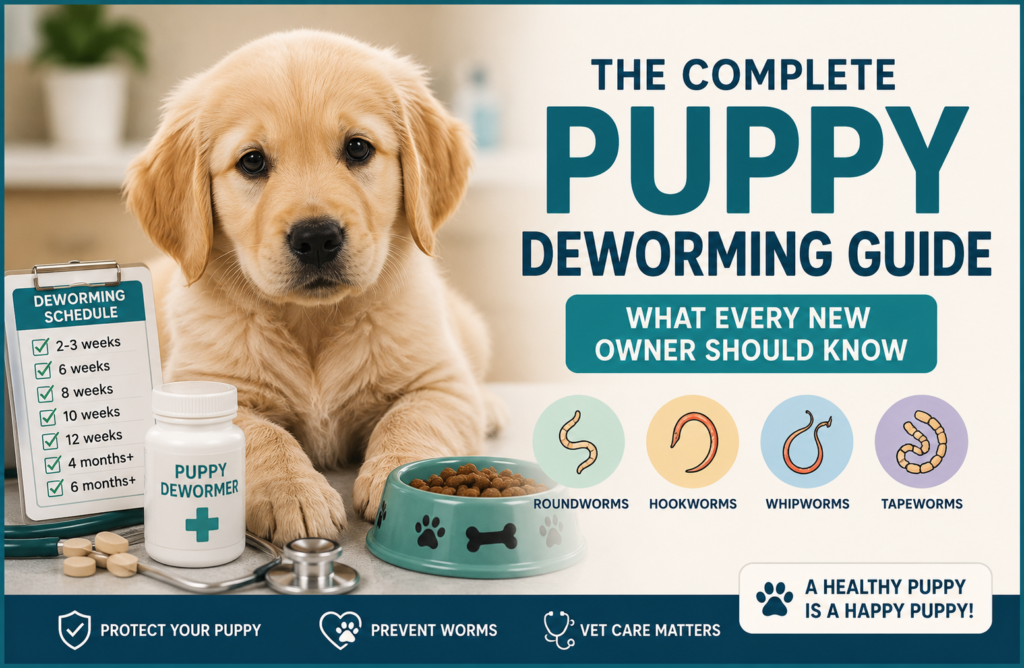
By Dr. Sami Ullah, DVM Bringing a puppy home is exciting — but almost every puppy, regardless of breed or breeder, starts life with some degree of intestinal parasite exposure. This isn’t a sign of poor care; it’s simply biology. Several common canine worms can pass from mother to pup before birth or through nursing, which is why veterinary references consistently recommend deworming puppies as a routine, preventive step rather than something done only when a problem is suspected. This guide walks through why puppies get worms, which parasites are most common, the deworming schedule recommended in veterinary references, and how to keep your puppy protected long-term. Why Almost Every Puppy Needs Deworming It’s tempting to assume that a clean, well-fed puppy from a reputable breeder wouldn’t have worms. In reality, veterinary parasitology sources note that roundworm larvae can migrate through the mother’s tissues and infect puppies before they are even born, or afterward through her milk. Because this transmission route is so effective, veterinary parasitologists advise assuming that essentially every puppy carries some developing roundworm burden, which is why routine deworming — rather than “wait and test” — is the standard recommendation for young pups. For this reason, the Merck Veterinary Manual notes that puppies commonly carry intestinal worms passed from their mother, and are typically dewormed as a preventive measure a few weeks after birth, with follow-up fecal checks every two to four weeks until two consecutive negative results are obtained. Common Intestinal Parasites in Puppies Veterinary references identify four parasites that account for the vast majority of puppy worm infections: 1. Roundworms (Toxocara canis, Toxascaris leonina) The most prevalent worm in puppies. Roundworms can cause a pot-bellied appearance, poor growth, vomiting, and diarrhea. Because of the mother-to-puppy transmission route described above, virtually all puppies are considered at risk regardless of the dam’s deworming history. 2. Hookworms (Ancylostoma caninum, Uncinaria stenocephala) These blood-feeding worms attach to the intestinal wall and can cause anemia, weakness, and dark or bloody stools, particularly in young or heavily infected puppies. Hookworms can also be transmitted through the mother’s milk. 3. Whipworms (Trichuris vulpis) Found in the large intestine (cecum and colon), whipworms attach firmly to the intestinal wall. Their eggs can survive in soil for years under the right conditions, making environmental sanitation an important part of long-term control. 4. Tapeworms (Dipylidium caninum, Taenia species) Tapeworms are segmented worms that are usually acquired indirectly — most often when a puppy swallows a flea during grooming, or occasionally through ingesting an infected intermediate host. They are generally less harmful than the other three parasites but are still worth treating, and flea control is essential to prevent reinfection. Signs Your Puppy May Have Worms Not every infected puppy shows obvious symptoms, especially early on, which is exactly why scheduled deworming (rather than symptom-based treatment) is recommended. That said, watch for: Any of these signs warrant a veterinary visit and a fecal examination, regardless of where your puppy is in its deworming schedule. The Recommended Deworming Schedule Veterinary manuals and canine anthelmintic product labeling converge on a similar timeline for young puppies, since the goal is to interrupt the parasite life cycle before eggs mature and re-infect the pup or contaminate the environment. A commonly cited schedule is: Puppy Age Action 2–3 weeks First deworming (often started this early because of prenatal/milk transmission of roundworms) 6, 8, 10, and 12 weeks Repeat treatment at each interval; the nursing mother is often treated at the same time 4 months onward Fecal exam and deworming as needed based on results 6 months+ Deworm at least twice yearly, or per your veterinarian’s parasite-risk assessment This schedule reflects guidance summarized in veterinary references and canine anthelmintic labeling (e.g., fenbendazole-based products), which recommend treating newly weaned pups at 6, 8, 10, and 12 weeks of age, alongside the dam, followed by at least twice-yearly deworming into adulthood. Some breeders and shelters begin even earlier, at 2 weeks, given how early prenatal transmission can occur. Important: No single dewormer treats every parasite equally well or at every life stage. A single dose typically only kills adult worms present at the time of treatment — it doesn’t affect migrating larvae — which is exactly why repeated dosing every two weeks through 12 weeks of age is necessary rather than a one-time treatment. How Deworming Medications Work Different classes of anthelmintics target different parasites: Your veterinarian will select the appropriate product and dose based on your puppy’s age, body weight, and known or suspected parasite exposure. Dosing by accurate body weight matters — under-dosing risks incomplete parasite clearance, while products not labeled for young puppies can carry safety risks. Fecal Testing: Why It Matters Because clinical signs are often absent or subtle, veterinary references recommend periodic fecal examinations rather than relying on visual inspection alone. The standard recommendation is fecal testing every 2–4 weeks during the puppy’s early deworming schedule, continuing until two consecutive negative results confirm the parasite burden has been cleared. Prevention and Environmental Control Deworming treats existing infections, but preventing reinfection depends heavily on environment and hygiene: Zoonotic Risk: Why This Matters Beyond Your Puppy Roundworms and hookworms are zoonotic, meaning they can infect people too — particularly young children, who are more likely to have soil or fecal contact. Human infection with Toxocara species can, in some cases, cause organ or eye involvement. This zoonotic potential is one of the key reasons veterinary and public health authorities emphasize routine, scheduled deworming of puppies rather than treating only visibly affected animals — it protects the household, not just the dog. When to Call Your Veterinarian Contact your vet promptly if your puppy: Never dose a sick, very young, or underweight puppy with an over-the-counter dewormer without veterinary guidance — some products carry age or weight restrictions, and an underlying illness should be ruled out first. Key Takeaways Always work directly with your veterinarian to tailor the schedule, product choice, and dosing to your specific puppy’s age, weight, and risk